The first Elder Scrolls Adventure will take place after the events of Khenarthi's Roost in Elder Scrolls Online. The Silvenar has been assassinated using Daedric poison by the Maomer to ensure that they can finalise their Tempest mission to summon a hurricane to destroy more Dominion ships in order to maintain their control over the seas and Khenarthi's Roost (an island belonging to the Khaijit). The Green Lady was persuaded to spare Ulondil, the ambassador and mer responsible for the assassination, and he was instead imprisoned and interrogated. However this didn't stop the mighty Tempest ritual from being undertaken where the Maomer fed storm energies into a mighty storm-slave who was designed to explode and wash the island over with such energy - tearing apart the mountain to the north and wiping off all life forms barring the Thunder Bugs. This ritual was undertaken while a number of Maomer were assaulting the island -- some of whom unknowing of their likely death.
The PCs, themselves, were found adrift in a rowboat having been on a ship that had been destroyed by the hurricane and miraculously having survived.
The Ebonheart Pact, however, has other plans. Seeing the establishment of a Naval Base, they had their most powerful Dunmer Mages open a portal to Khenarthi's Roost where they sent three Dunmer mages and two Nord swordsmen to investigate. Using mystical illusions and stolen uniforms, they appeared to be Altmer Members of the Dominion Marines. Through quick investigation they located some of the most important people in town as well as Captain Irinwe's maomer ship which cowered in the northern isolated stretches of the island.
The Dunmer, Mivrose Rilrethi, donned the captain's likeness and stole aboard her ship. He lay an alchemically treated handkerchief to her mouth and when she fell unconscious he placed her in a chest and had the crewmen take the chest down to a room belowdecks which she locked. Since the ship had fewer crewmen (too many slaughtered in the attacks ashore), it was easy enough to refuse the crew that one room.
The Dunmer, Galydasea Krevyn, forged a writ from Headwoman Harrani so that she could enter the Maomer embassy where Ulondil was held imprisoned and feed him drugged wine. During a gap in the guard's change, she ingested a Potion of Strength so she could pick up and carry Uldonil back to the ship.
The Nord, Kottami Sabletongue, simply strode into the Chancery to speak with Headwoman Harrani alone and using his feigned rank of captain, convinced her of potential treachery in the ranks. He led Headwoman Harrani out of the building, using the whispered conversations of other guards as evidence of their illdoing, and then while they were out of sight of all, he struck her over the back of the head and hid her in a cart that he pulled all the way back to the ship.
The Nord, Hamasel the Innocent, an ironic name if ever there was on, drew the attentions of Vicereeve Pelidil over sincere and shared distaste for Khajiit food and drink (too sweet). When they went for a walk together, she clubbed him over the back of the head, threw him in a bag, and carried him back to the ship.
Evuliban Dresnimn, however, had been speaking to Gathwen, Rurelion's Apprentice and member of the Mage's Guild. He learned how she was part of an expedition to the Mourning Springs Temple on Khenarthi's Roost with her master, Rurelion, but they disturbed an ancient maomer mage called Uldor and one of the two of them had to offer themselves up as a suit so that he could be entombed once more. Rurelion was the one selected to be entombed with him. Gathwen still misses him terribly and is eager to find a way to free him yet leave Uldor trapped. After all, as she will counsel, Rurelion is a fine teacher who is taught even some of Queen Ayrenn's advisors. Evuliban, curious about this possibility, questioned her further and learned that Uldor's brief freedom had been triggered by the mage, Ealcil's, removal of the mourning stone which produced a plentiful bounty of water that had kept Uldor locked in his body. Evuliban filled her head with fanciful information about a hidden temple rumoured to be in the northernmost stretches of the island and then while camped out there he drugged her wine.
Evuliban Dresnimn has a plan. While Mivrose Rilrethi and Hamasel the Innocent take the Serpent's Kiss back up to their place, Kottami Sabletongue, Galydasea Krevyn and himself will visit the Mourning Springs Temple to free Uldor and set him against Khenarthi's Roost and possibly Elsweyr itself -- knowing that he would likely wipe out them all out.
The PCs will be victims of this enterprise - kidnapped along with the others.
Race Guide
Equipment Guide
Adventure Part 1 - Retaking the Viper
Adventure Part 2 - Return to the Roost
Adventure Part 3 - Revelations of the Tomb
PS. For those who are interested in running this adventure, be aware that I am using my own mix up of the World of Darkness. Don't worry, though, you could run it in Pathfinder using these custom rules and simply advise the players to pick classes that fit the Elder Scrolls universe. Or you could run it in any other custom system and simply use the adventure itself, if you like.
Monday, September 22, 2014


Sunday, September 21, 2014
Khenarthi's Roost Adventure - Part 1 (Retaking the Viper)
Please check the basic adventure overview here if you haven't already. I ran this adventure with the players gaining dots on their sheet depending on their actions, choices, beliefs, etc. for a total of 24 points. Since I've been using the God Machine System where all skills have the same cost regardless of dot level, this worked really well so long as you ensure that you hand out skill dots at around the same time so that all the players end up with the same number of dots. I gave them 7, 5, 4 attribute dots that they could spend as normal and helped them decide on 10 merit dots (basically spruiking likely ones and seeing if there were any takers). Not all players will enjoy this route but mine did which is likely because it's a series of one shots rather than a campaign.
The players and the GM must figure out the how and why behind the PCs presence on the ship. In my case, the Bosmer guard of the Silvenar (now sadly out of a job) drank too much and passed out on the street - and was taken from there; the Dunmer merchant was given a doped drink because the kidnappers considered him a traitor; and the third Dunmer had been trying to sneak her way to Auridon and so smuggled herself aboard their ship.
Ooh, also ensure the PCs have a name, too, at this stage. When in doubt, this name generator can help a lot.
One of the PCs has been cuffed using the trick cuffs Captain Irinwe keeps in her room for entertainment purposes. It's necessary that at least one isn't properly cuffed so that they can loosen the others - ideally a larcenous type. All are bound though none are gagged, without weapons or armour. Odds are they'll notice Captain Irinwe first.
Just as a pointer on Maomer ships, the ship has membranous sails and a rugged chitin hull with a rather narrow waistline that gives it an insectoid appearance. Internally it is much like most sailing ships.
The PCs have company:
The group may plot quietly together though naturally there are many recriminations. Vicereeve Pelidil is quick to order the deaths of the two Maomer. Ulondil tries to purchase his freedom while retaining dignity though he won't bother convincing any Bosmer once they figure out who he is (since he did orchestrate the death of their holy Silvenar). Harrani cautions careful consideration of one's choices though she won't argue against anyone killing Ulondil now beyond a token effort at remaining civilised. Captain Irinwe has no interest in Ulondil and bargains for herself - stating that she can reclaim her ship since her own people crew it and that she will let the others free if they help her escape (she isn't sure if she's telling the truth or not).
Only Captain Irinwe will offer to assist them in a battle as the others have no skill at it.
Once there is some semblance of order, generally once the door is picked, they will hear a single set of footsteps echoing across the wooden boards. Only two can attack at once. If they leap out at the figure they can get a single turn worth of attacks before it goes to initiative. The figure is a Sea Viper crewman with a sword that will take a turn to draw (giving the players two turns to take him out even if he wins the initiative). If he gets the chance to draw his sword, he will also call out to his friends. If all of his health boxes fill with bashing, he will fall unconscious.
The other room, whose door stands open, has two sleeping Maomer still fast asleep and snoring (unless awoken by shouts). Naturally Captain Irinwe, if alive, will want them unconscious. She will also direct the players down into the hold to get their equipment from a chest (within which is another set of manacle keys should any of the PCs still be cuffed because the lockpicking roll failed).
NB: All characters at this level have either a simple destruction staff, iron weapons and armour or novice mage robes. They may also have 50gp OR 2 Minor Magicka Potions OR Minor Health Potions. If a PC should have had better gear beforehand, assume that it was stolen away from them or they have otherwise lost it. In a game like this, loot is an important part of the puzzle.
There are three Maomer around the table, each armed with swords, who will be taken aback if Captain Irinwe is seen but upon seeing her with the prisoners will believe that she is the Dominion caster kidnapped by their captain (the caster called Gathwen). They will therefore attack.
Allow the PCs to be clever about this if they would like. I instituted a semi-move action, like you get in Pathfinder, so that they could do things like shut a door between two enemies without giving up their full action to do so - while forcing the enemies to spend a turn reopening it.
Once they're dealt with they'll see a door leads to the companionway up into the aftcastle where they'll find Captain Irinwe's cabin. Should they explore her cabin they will find a series of her maps overlaid on the table as well.
They will also find Hamasel the Innocent who was sleeping in a sheer shift on the bed and who pretends to be a Nord slave, claiming to have been taken from the First Auridon Marines as they had considered her a traitor to her kind (9 dice on Subterfuge). She will allow herself to be tied up (8 dice on Athletics to later escape) or will alternatively trail after them unarmed and will attack them if the tide of combat turns on them. If they subdue those abovedecks too rapidly, she will continue in her role of innocent ingénue and see what information she can gather before ultimately betraying them. She is a sociopath and will happily see the Dunmer die to protect her cover. She also won't overplay her position - she has no interest in actively seducing anyone though she might happen to flirt to see them squirm.
Captain Irinwe will not be pleased if they loot her cabin though at present she has merely 3 glowing mushrooms (alchemy ingredient - 5gp), 2 bowls of moonsugar (alchemy ingredient - 50gp), salt shaker equivalent to 3 salt piles (alchemy ingredient - 2gp), and 5 small pearls (alchemy ingredient - 2gp). There is also a tankard of Reedwine (weak alcohol provides a +1 stamina buff to all stamina-based dice rolls) and a honey treat.
There are five individuals above decks including the Dunmer, Mivrose Rilrethi. Four of them are just the regular crewmen and they all assume Mivrose is the captain - an illusion which will stand until Mivrose is either rendered unconscious or slain. Mivrose, an accomplished illusionist, will use spells to subtly set events in his favour.
Gathwen, Rurelion's Apprentice and a Bosmer member of the Mage's Guild, is gagged, bound and locked in a small cage on the deck. If freed, she would join the fight but unless the key is taken from Mivrose, it will take far too long to pick the lock on both cage and manacles and remove the gag. Thus her combat statistics are not included in this article.
Presuming that Captain Irinwe is still alive, once Mivrose Rilrethi has been knocked down, she will command any remaining crew to lay anchor and have a meal in celebration regardless of Gathwen's desperation to return to stop the other kidnappers. They lack the numbers to sail the ship, after all (require 5 plus the captain to get the vessel going).
The PCs may gather their wits, converse and make plans at this stage. They might interrogate Mivrose, if they like, though he has little information immediately relevant to their plans and won't give up Hammasel the Innocent unless tortured.
If Ulondil lives, his mere presence may convince Captain Irinwe to set sail for their home island with their valuable cargo and she will feign heading in the direction of Khenarthi's Roost to set them at ease (subterfuge or survival rolls will reveal the ruse) and a further battle is required to send them in the right direction. If he is killed or otherwise kept tied up and out of her way, she will put up the white flag to meet the Aldmeri Navy and hand them over. The Navy will allow her to leave ... though with gritted teeth. To do otherwise would doom their own people. Hammasel the Innocent will aim to leave with them, if at all possible, and if still alive.
The players and the GM must figure out the how and why behind the PCs presence on the ship. In my case, the Bosmer guard of the Silvenar (now sadly out of a job) drank too much and passed out on the street - and was taken from there; the Dunmer merchant was given a doped drink because the kidnappers considered him a traitor; and the third Dunmer had been trying to sneak her way to Auridon and so smuggled herself aboard their ship.
Ooh, also ensure the PCs have a name, too, at this stage. When in doubt, this name generator can help a lot.
One of the PCs has been cuffed using the trick cuffs Captain Irinwe keeps in her room for entertainment purposes. It's necessary that at least one isn't properly cuffed so that they can loosen the others - ideally a larcenous type. All are bound though none are gagged, without weapons or armour. Odds are they'll notice Captain Irinwe first.
Just as a pointer on Maomer ships, the ship has membranous sails and a rugged chitin hull with a rather narrow waistline that gives it an insectoid appearance. Internally it is much like most sailing ships.
The PCs have company:
- Captain Irinwe, a strong-willed and rather scathing Maomer who normally makes runs between the Maomer Embassy on Khenarthi's Roost and Pyandonea on her vessel, the Sea Viper.
- Vicereeve Pelidil, an Altmer supremacist male who serves Prince Naemon and prefers him to Queen Ayrenn.
- Ulondil, a Maomer who had been imprisoned in his own embassy following the Tempest Unleashed who sees no value in Khenarthi's Roost now that it has breached its own treaty to allow the Dominion safe harbour.
- Harrani, the Headwoman Khajiit who leads the people of Khenarthi Roost and who is generally both cautious and unassuming.
The group may plot quietly together though naturally there are many recriminations. Vicereeve Pelidil is quick to order the deaths of the two Maomer. Ulondil tries to purchase his freedom while retaining dignity though he won't bother convincing any Bosmer once they figure out who he is (since he did orchestrate the death of their holy Silvenar). Harrani cautions careful consideration of one's choices though she won't argue against anyone killing Ulondil now beyond a token effort at remaining civilised. Captain Irinwe has no interest in Ulondil and bargains for herself - stating that she can reclaim her ship since her own people crew it and that she will let the others free if they help her escape (she isn't sure if she's telling the truth or not).
Only Captain Irinwe will offer to assist them in a battle as the others have no skill at it.
Captain Irinwe
Weapon To Be Stolen (6 dice to use)
Initiative 5
Speed 11
Defence 5
Armour To Be Stolen
She
automatically gains +3 bonus to stealth checks while remaining still and enemies take a -2 penalty to see
her even when she is moving so long as she is over 20 yards away.
Summon Sea Serpent
You may summon a small sea serpent (Size 3) out
of the ether to fight by your side for 6 rounds once per day. It has 6 dice (0 lethal) and a Toxicity 3
bite.
Once there is some semblance of order, generally once the door is picked, they will hear a single set of footsteps echoing across the wooden boards. Only two can attack at once. If they leap out at the figure they can get a single turn worth of attacks before it goes to initiative. The figure is a Sea Viper crewman with a sword that will take a turn to draw (giving the players two turns to take him out even if he wins the initiative). If he gets the chance to draw his sword, he will also call out to his friends. If all of his health boxes fill with bashing, he will fall unconscious.
Maomer Crewman
-1 Iron Sword (5 dice to use)
Initiative 4
Speed 10
Defence 4
Hide Armour 1
Minor Health Potion
The other room, whose door stands open, has two sleeping Maomer still fast asleep and snoring (unless awoken by shouts). Naturally Captain Irinwe, if alive, will want them unconscious. She will also direct the players down into the hold to get their equipment from a chest (within which is another set of manacle keys should any of the PCs still be cuffed because the lockpicking roll failed).
NB: All characters at this level have either a simple destruction staff, iron weapons and armour or novice mage robes. They may also have 50gp OR 2 Minor Magicka Potions OR Minor Health Potions. If a PC should have had better gear beforehand, assume that it was stolen away from them or they have otherwise lost it. In a game like this, loot is an important part of the puzzle.
There are three Maomer around the table, each armed with swords, who will be taken aback if Captain Irinwe is seen but upon seeing her with the prisoners will believe that she is the Dominion caster kidnapped by their captain (the caster called Gathwen). They will therefore attack.
Allow the PCs to be clever about this if they would like. I instituted a semi-move action, like you get in Pathfinder, so that they could do things like shut a door between two enemies without giving up their full action to do so - while forcing the enemies to spend a turn reopening it.
Once they're dealt with they'll see a door leads to the companionway up into the aftcastle where they'll find Captain Irinwe's cabin. Should they explore her cabin they will find a series of her maps overlaid on the table as well.
They will also find Hamasel the Innocent who was sleeping in a sheer shift on the bed and who pretends to be a Nord slave, claiming to have been taken from the First Auridon Marines as they had considered her a traitor to her kind (9 dice on Subterfuge). She will allow herself to be tied up (8 dice on Athletics to later escape) or will alternatively trail after them unarmed and will attack them if the tide of combat turns on them. If they subdue those abovedecks too rapidly, she will continue in her role of innocent ingénue and see what information she can gather before ultimately betraying them. She is a sociopath and will happily see the Dunmer die to protect her cover. She also won't overplay her position - she has no interest in actively seducing anyone though she might happen to flirt to see them squirm.
Captain Irinwe will not be pleased if they loot her cabin though at present she has merely 3 glowing mushrooms (alchemy ingredient - 5gp), 2 bowls of moonsugar (alchemy ingredient - 50gp), salt shaker equivalent to 3 salt piles (alchemy ingredient - 2gp), and 5 small pearls (alchemy ingredient - 2gp). There is also a tankard of Reedwine (weak alcohol provides a +1 stamina buff to all stamina-based dice rolls) and a honey treat.
There are five individuals above decks including the Dunmer, Mivrose Rilrethi. Four of them are just the regular crewmen and they all assume Mivrose is the captain - an illusion which will stand until Mivrose is either rendered unconscious or slain. Mivrose, an accomplished illusionist, will use spells to subtly set events in his favour.
Mivrose Rilrethi
+0 Steel Sword (3 dice to use, doesn't use)
Initiative 6
Speed 9
Defence 3
Magicka 10
Fire Resistance (takes bashing damage from fire)
Novice Mage Robes of Illusion +1 die rolls
Minor Health Potion x 2
Magicka Potion
Anchorstone Amulet: Increase healing times by 25%.
Created from a chunk of rock broken off of a Dark Anchor dolmen, this amulet still whispers Coldharbour's secrets.
Cloak self in flame for 6 rounds, once per day,
those who strike you in melee range take 1 fire damage
Gathwen, Rurelion's Apprentice and a Bosmer member of the Mage's Guild, is gagged, bound and locked in a small cage on the deck. If freed, she would join the fight but unless the key is taken from Mivrose, it will take far too long to pick the lock on both cage and manacles and remove the gag. Thus her combat statistics are not included in this article.
Presuming that Captain Irinwe is still alive, once Mivrose Rilrethi has been knocked down, she will command any remaining crew to lay anchor and have a meal in celebration regardless of Gathwen's desperation to return to stop the other kidnappers. They lack the numbers to sail the ship, after all (require 5 plus the captain to get the vessel going).
The PCs may gather their wits, converse and make plans at this stage. They might interrogate Mivrose, if they like, though he has little information immediately relevant to their plans and won't give up Hammasel the Innocent unless tortured.
If Ulondil lives, his mere presence may convince Captain Irinwe to set sail for their home island with their valuable cargo and she will feign heading in the direction of Khenarthi's Roost to set them at ease (subterfuge or survival rolls will reveal the ruse) and a further battle is required to send them in the right direction. If he is killed or otherwise kept tied up and out of her way, she will put up the white flag to meet the Aldmeri Navy and hand them over. The Navy will allow her to leave ... though with gritted teeth. To do otherwise would doom their own people. Hammasel the Innocent will aim to leave with them, if at all possible, and if still alive.
Friday, September 19, 2014
Elder Scrolls: Basic WoD Equipment
For those planning to also run an Elder Scrolls game using God Machine's World of Darkness rules set, this is where I will putting equipment as I create it for the game. Naturally you could also use some of the Fianyarr equipment lists but this stuff is specifically created to match Elder Scrolls items.
The bow type affects damage bonus (automatic damage added to successes from the attack roll) and range.
Longbow 0L 25 yards
Hunting Bow 0L 35 yards
Orcish Bow 1L 25 yards
Dwemer Bow 1L 35 yards
Elven Bow 2L 25 yards
Bosmerian Bone Composite Bow 2L 35 yards
Glass Bow 3L 25 yards
Ebony Bow 3L 35 yards
Daedric Bow 4L 25 yards
Dragonbone Bow 4L 35 yards
Arrows of these particular materials gain an attack penalty or bonus equal to the listed number. Melee weapons (i.e. swords) of these particular materials gain and attack and damage penalty or bonus equal to the listed number. Yes, this means that melee weapons can do way more damage eventually than a bow but you have to get in close and personal to do it which means taking more damage.
Rusty -2
Iron -1
Steel +0
Elven +1
Orcish +2
Dwemer +3
Glass +4
Ebony +5
Daedric +6
Armour downgrades damage (i.e. from lethal to bashing) from each single hit by the amount mentioned below. Additional pieces of armour (greaves, bracers, pauldrons, helmets, boots, etc.) on top of the cuirass simply protect against called shots.
Light armour rarely provides any penalties as it's easier to wear. Use the prices on the various Skyrim wikis but bear in mind that Elven light armour should always cost more than steel armour which is the less effective but cheaper option. It should also be rare to find glass or daedric light armour as well.
Rawhide +1 armour, -1 Initiative
Hide / Fur +1 armour
Leather +2 armour
Elven / Scaled +3 armour
Glass +4 armour
Daedric +5 armour
Heavy armour provides a -2 penalty to Initiative and Stealth.
Rusty +3 armour, additional -2 penalties
Iron +3 armour, additional -1 penalties
Steel +3 armour
Dwemer +4 armour
Orcish +5 armour
Ebony +6 armour
Voidstone +7
Daedric +8 armour
Magicka Potions heals Magicka equal to the listed number. Healing Potions heal lethal damage equal to the listed number OR if there's not enough lethal damage to heal it heals twice as much bashing damage instead.
Minor Magicka / Health Potion: +2
Magicka / Health Potion: +3
Plentiful Magicka / Health Potion: +4
Potent Magicka / Health Potion: +5
Extreme Magicka / Health Potion: +6
Ultimate Magicka / Health Potion: +7
Destruction Staff
Select Flame, Ice, or Electricity
Intelligence (for electricity) OR Presence (for flame) OR Resolve (for ice) + Staff.
Range is equivalent to Intelligence + Presence + Resolve x 2.
Costs 1 Magicka to use.
Successes deal lethal damage unless the character has resistance (deals bashing damage) or vulnerability (deals aggravated damage).
Robes provide no armour bonus but do assist the caster by reducing the Magicka regeneration rate and providing a dice bonus from particular schools. Additional enchantments can be lain on these garbs. Where two materials are listed, the second one is specifically for Bosmer who have sworn the Green Pact though natural anyone could wear them.
Novice Mage Robes (Jute / Coarse Spidersilk)
+1 bonus to dice rolls from a particular magic school. Reduces Magicka regeneration rate from 1 hour to 30 minutes. Requires Novice or higher ability in that school of magic.
Apprentice Mage Robes (Spidersilk)
+2 bonus to dice rolls from a particular mage school. Reduces Magicka regeneration rate from 1 hour to 15 minutes. Requires Apprentice or higher ability in that school of magic.
Adept Mage Robes (Kresh Fiber / Ebonthread)
+3 bonus to dice rolls from a particular mage school. Reduces Magicka regeneration rate from 1 hour to 5 minutes. Requires Adept or higher ability in that school of magic.
Expert Mage Robes (Ironthread / Silverweave)
+4 bonus to dice rolls from a particular mage school. Reduces Magicka regeneration rate from 1 hour to 1 minute. Requires Expert or higher ability in that school of magic.
Master Mage Robes (Void Cloth)
+5 bonus to dice rolls from a particular mage school. Reduces Magicka regeneration rate from 1 hour to 1 round. Requires Master or higher ability in that school of magic.
What do you guys think? See any problems with this? I'll be playtesting some of it this weekend so I'll tell you what I find.
Monday, September 15, 2014
LARP Organisation - Financial Costs or Why We Have Membership Fees
One of the things rarely mentioned in the various Create a LARP web-links I've found is the actual nitty gritties of the boring stuff that must go on in the background. If you're in a litigious society, especially one where venues require public liability insurance and offer discounted rates to registered Not For Profits, you'll need to do quite a bit more to run a campaign LARP than simply hire a place and offer tickets.
You see, an event LARP can afford to pay the higher rates for a venue so long as it's relatively prop-lite / uses props already owned. People will generally pay a higher ticket cost for something that has so much extra prep-work going into it than the more self-sufficient (but still time intensive) campaign LARPs where players must shoulder some of the burden in character creation, goal setting and interaction. I think it's also partly because an annual event also feels more special than a monthly one so people can justify to themselves spending a little more (i.e. $15 instead or $3 - $5).
Generally private venue hire includes public liability insurance coverage (at least in South Australia) where your event can come under the venue's own insurance contracts. Most venues have a limit of, say, four hires per year where you can do this. This is basically a 'Private Hire' and explains how people can hire such places for birthday parties and other celebrations without having to take out event insurance ($250 a pop).
If you wanted to run a campaign LARP under the private venue hire rules in South Australia, you could still do it using the higher hourly rates but you'd need to change the venue every fifth time in a year. True, you could run it as an unincorporated association (i.e. informal club) but very few organisations / councils recognise them and insurance companies certainly don't.
In Adelaide, the average meeting room has an hourly rate of $10 - $20 for a private hire. Larger spaces like halls tend to sit between $40 - $75 an hour, especially on weekends (Friday night to Sunday night). If you want meeting rooms on top of that, you have to pay the combined rates.
Generally Not For Profits get to pay half to a quarter of that rate - sometimes meeting rooms will be free though halls rarely are unless you get really lucky. They do need someone to contribute to the cost of the building's overheads and all that. (Increasingly venues won't offer reduced rates on weekends due to a lack of funding from other sources - so even as a Not For Profit you need to shop around).
Therefore becoming a real Not For Profit can save you a lot of money. I don't yet know the cost of public liability insurance (which covers damage to property and passersby) for a dice LARP but boffer LARP insurance can cost around $1800 for $10 million insurance. That boils down to $150 per session if you run 12 a year - which compared to $250 for event insurance for each game for a private hire, is a saving of $100.
Of course, very little is free these days. Not only does a Not For Profit require a constitution and a committee, but there's an incorporation fee (currently $181) alongside other sundries such as cash boxes, ledger books, occupational first aid kits (potentially sporting first aid kits), and rubber stamp.
Then when running the actual events, there are venue fees that will generally range between $10 to $20 an hour if you're clever and lucky, insurance that could reach up to $1850, and a bond for the events that can range from nil (rare), $250 (less common) to an average of $500 and a high of $1000. That's a lot of money to put up front for an event and it's likely to come out of the organiser's pockets and you don't get the bond back until after you stop using that venue.
This is the reason why most LARP organisations charge some kind of membership fee on top of the actual session fee. There are a lot of costs and if you want to get to the point where you can pay deposits and bonds as well as purchase props without digging into the organiser's pockets and reimbursing them later on, then there also needs to be a small profit per event. This profit can also help the game survive if there's a small slump in either members or attendees. If you're barely breaking even then even one player dropping out can put you in the red.
There are alternatives naturally but in Australia you have all the legal responsibilities (as an unincorporated association) but fewer protections, can't apply for grants, can't open a bank account for the organisation and will likely need to run the game out of your own house. There are also convention LARPs which normally involve a single event run using the insurance provided by the convention itself. Either option can work for some LARPs and not for others.
So ... any thoughts? Any queries? What's it like in other countries?
(Also, let me know if this article isn't very clear. There's a lot of details in there and it's easy to make it over convoluted and confusing.)
Monday, September 8, 2014
Elder Scrolls Meets Demon the Fallen (Adventure Prelude)
 |
| At least they aren't summoned into Hermaeus Mora's realm. (Skyrim picture) |
Their mental skills include Academics, Alchemy, Folklore, Investigation, Magical Sciences, Politics, Smithing, Science while their physical skills include Athletics, Brawl, Archery, Larceny, Staff (magic), Sneak, Survival and Weaponry. Their social skills are much the same as in any World of Darkness game.
The players must first select a fallen name for their Aedra. If they can't immediately come up with one, using a random generator for god names, angel names and demon names will help.
Then the game itself starts with the characters lost and adrift within darkness with dim memories of being partially responsible for the creation of a sterile and breathtaking universe alongside the other Aedra where all was perfection and stasis. Lorkhan saw that it was sterile and convinced a number of the Aedra that the world needed to be set in reality and gifted to creatures that could explore and wander at it. While most of your kind were repulsed by the very idea, Lorkhan's words proved very inspirational to some. You were one of those many Aedra who sided with Lorkhan and helped remake the world. The other Aedra warred with you. Many fell. Some were destroyed by their acts of creation itself.
Each Aedra who bought into Lorkhan's plan came to specialise and fall within a few small realms. At this stage the GM should offer seven keywords and ask the PCs to pick the one they like the most which describes their starting concept: Leadership, Protection, Construction, Comprehension, Inspiration, Evolution and Solace. Once a term is selected, read out the three sub-houses and have the player pick their favourite.
For those players who want a less whimsical character creation, simply go straight for reading out the below information and have the players choose at the end.
Either way, each sub-house provides a bonus to an attribute, provides a magical discipline dot and a single spell. The discipline dot represents what level of spell that PC can learn. 1 dot: Novice. 2 dot: Apprentice. 3 dot: Adept. 4 dot: Expert. 5 dot: Master. The free spells are from the Mage: the Awakening core rulebook except for Alter Voice which simply allows the fallen to change their voice for a scene. Each Novice spell costs 1 Magicka to cast. They don't get access to the usual Demon: the Fallen lores and may only select 4 points worth of apocalyptic form traits (more will be unlocked in future).
Leadership
The Namaru (+1 Presence and Resolve) were those who concerned themselves with enhancing the Magicka of others to achieve the will (Bel), who used such Magicka from light to forge the flame within the world and who pierced the sky to allow in Aetherial light in the form of the suns and star (Nusku) and who kindled sentience in the minds of certain races to elevate them from a beast's instincts (Qingu).Bel = Alteration (Dispel Magic) - Presence + Magical Sciences
Qingu = Mysticism (Sense Consciousness) - Wits + Empathy
Nusku = Alteration (Control Heat) - Presence + Science
Protection
The Asharu (+1 Dexterity and Wits) were those who understood how to bring life to form to separate matter for existence (Dagan), who spoke within the minds of those made sentient to give them guidance (Anshar) and who spread air upon the land to separate the heavens from the worlds themselves (Elil).
Anshar = Mysticism (Sense Life) - Wits + Investigation
Dagan = Restoration (Healer's Trance) - Wits + Science
Elil = Alteration (Influence Sound) - Presence + Expression
Construction
The Anunaki (+1 Strength and Intelligence) were those who had sculpted some of the sterile matter and now they gave themselves to crafting the laws of the worlds to make them traversable to the living things (Antu), to building into the weave of items the properties of magic that would allow one to gift one's favourites with power (Mummu) and who played with the soil and rocks to make an intriguing landscape capable of giving forth life (Kishar).
Antu = Alteration (Angle Paths) - Wits + Survival
Kishar = Mysticism (Detect Substance) - Wits + Smithing
Mummu = Enchanting (Analyse Enchanted Item) - Wits + Magical Sciences
Comprehension
The Neberu (+1 Wits and Intelligence) were those who were set to divine the reactions of the Aedra (Ninsun), draw down the magicka from the sky and turn it into light so that all might see (Shamasha), and to open the Ways between places that were otherwise set into traversable lines so that one could - if one needed - leap from one place to the next in an instant (Nedu).
Nedu = Mysticism (Spatial Awareness) - Wits + Survival
Ninsun = Mysticism (Finder) - Wits + Investigation
Shamash = Alteration (Influence Light) - Presence + Magical Sciences
Inspiration
The Lammasu (+1 Wits and Manipulation) were those who knew that living beings would require a changing world and so they cast weather and water to change the lands (Adad), provided clues and hints and whispers that would inspire the living to find their own answers (Ishhara), and to best inspire them they learned ways of walking among them unseen so that they appeared as any other living thing (Mammetum).
Adad = Restoration (Sense Poisons & Drugs) - Wits + Alchemy
Ishhara = Mysticism (Aura Perception) - Wits + Empathy
Mammetum = Illusion (Alter Voice)* - Manipulation + Expression
Evolution
The Rabisu (+1 Stamina and Intelligence) were those who took the desires of the other Aedra and made them into whole creatures so that the worlds could be overrun with species of every kind, both plant (Ninurtu) and animal (Zaltu), and who then turned their designs to shaping those given sentience by the Asharu so that they could be better shaped to use such minds (Aruru).
Aruru = Restoration (Forego Rest) - Stamina + Survival
Zaltu = Restoration (Analyse Life) - Intelligence + Alchemy
Ninurtu = Mysticism (Pulse of the Living World) - Wits + Survival
Solace
Finally for life to exist, so must death, for without the latter no change is possible and all is doomed to sterility, so the Halaku (+1 Resolve and Composure) came forth to take on this sacred task by reclaiming the matter from the dead so that none may puppet them in death (Namtar), providing solace to the dead souls before returning them to this world in forms anew (Nergal), and crafting underworld landscapes for temporary afterlives in keeping with the needs of mortal minds so that there would be respite between life journeys (Ereshkigal).
Namtar = Mysticism (Forensic Gaze) - Intelligence + Investigation
Nergal = Conjuration (Speak With The Dead) - Resolve + Expression
Ereshkigal = Alteration (Shadow Sculpting) - Dexterity + Folklore
The darkness widens into a purplish light and a feminine voice commands them to come and they do, drawn out into the ancient bastion of Moonshadow, a place lit in bright lilacs and purples, with glistening white crystal stoneworks forming the bulk of the buildings. They may roam its silent halls and rose gardens for a short while before Azura's voice speaks to them once more and commands them to fill the bodies of those whose souls have been stolen by soul gems.
Azura draws them via a silvery-violet light into a Great Hall filled with niches where statues of the various races stand around them. The players may choose their race from the core ten. Once chosen, they merge with the individual and disappear from this realm to enter the other world (see Khenarthi's Roost adventure).
NB: I have a document filled with the races and their racial bonuses. I may post up the information at a later date if there's much interest.
Wednesday, September 3, 2014
Demon: Lore of Wilds
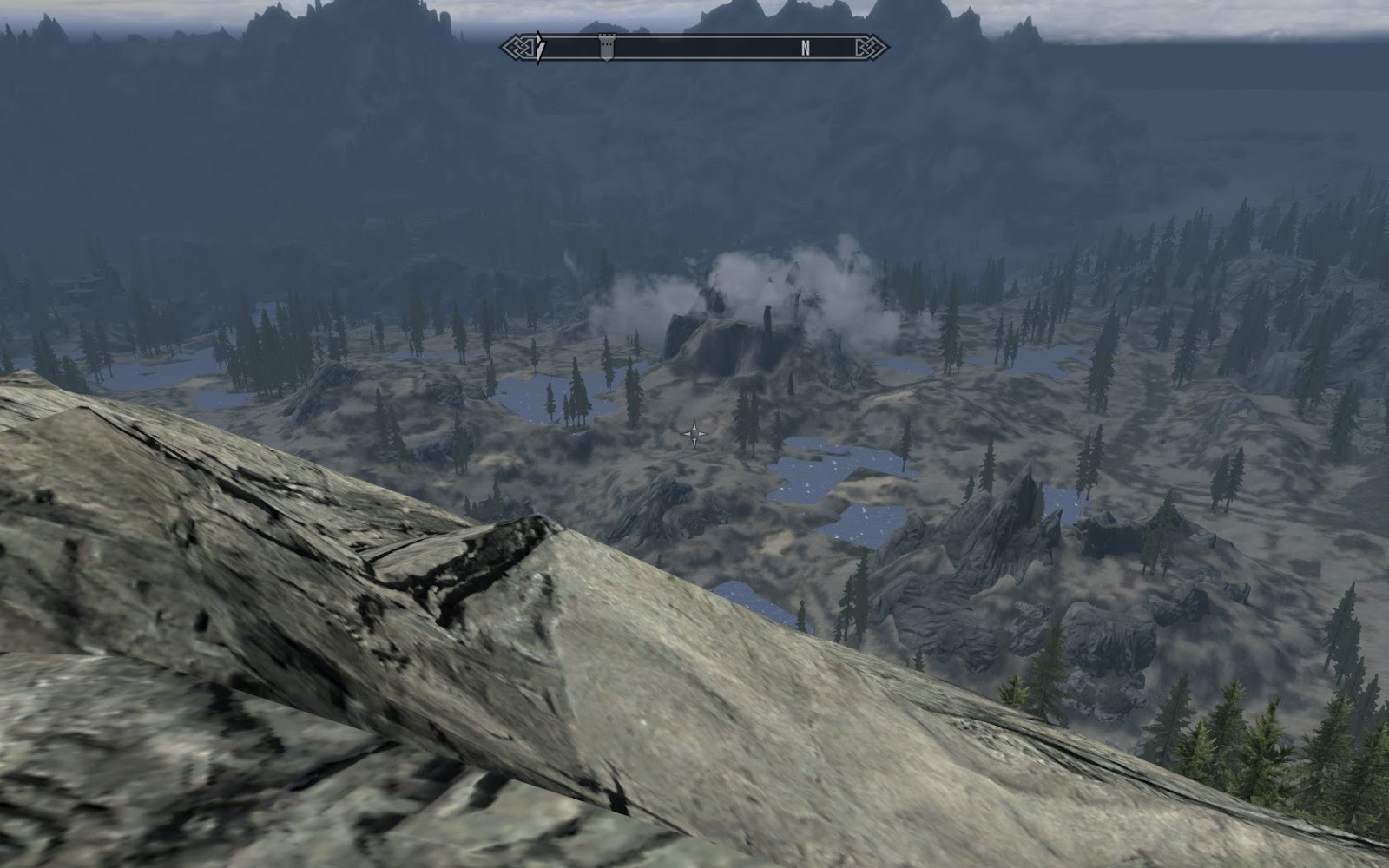 |
| Wilds gives control over nature's glories. (Skyrim picture) |
Action: Instant.
Cost: None.
Dice Pool: Wits + Survival + Wild.
High Torment: You can force a clash of wills against obfuscated or invisible creatures within the air by linking your mind more directly and forcefully with the general wilderness.
Quicken Growth
You can provide sustenance to all flora within miles equal to Faith as though they had been recently fertilised OR you may instantly revivify a single plant you touch which has recently died causing it to bud new leaves before one's very eyes OR you can cause a single plant or tree to bear fruit or some other seasonal product within seven rounds.Action: Instant.
Cost: None.
Dice Pool: Presence + Survival + Wild.
High Torment: You can damage all flora within miles equal to Faith as though you had recently sprayed a weak pesticide upon them OR you may instantly kill a single plant you touch causing it to wither and die OR you can cause a single plant or tree to bear fruit that appears healthy but is actually poisonous (Toxicity 3 poison).
Command the Wild
You can cause a single woody plant or several bushy ones within yards equal to Faith to grow in size and thickness, creating cover that has armour equal to successes for yourself OR you can cause a single seed to sprout and gain size equal to successes OR you can make a tree or similarly large plant move a limb in an attack that deals bashing damage whose dice pool is equal to your successes.Action: Instant.
Cost: None.
Dice Pool: Presence + Survival + Wild ( - Defence).
High Torment: You can attack others using a tree limb as a reflexive action.
Possess Plant
You can enter any plant that you are touching and pass through their root systems from plant to plant and tree to tree. You can travel anywhere within miles equal to Faith in this manner anywhere that has enough plants (i.e. tree-lined streets and lawned gardens would do, sandy deserts and largely bitumen and tarmac wouldn't). If you have previously cast Wilderness Sense, you can then use your regular senses as though you were standing in the place of a particular plant (as in a manner of speaking, you are). If for some reason you must pass through a reasonable distance of dead plants, you may do so with the expenditure of a willpower point which will revivify them (giving them another shot at life).Action: Instant.
Cost: 1 Faith.
Dice Pool: Intelligence + Survival + Wild.
High Torment: You can cause the vegetation you pass through to wilt and begin to die but until then those you nominate (up to Faith in number) will suffer a -2 environmental penalty to any rolls made while traversing plant-filled areas (including garden lawns) which can cause mishaps that have their own damage dice pool equal to your successes on the roll (i.e. tripping over a tree root and landing on a garden gnome). This dice pool is only bashing but as the damage / troubles last for a day it can certainly add up.
Mutate Plant
You can enter change any of a plant's characteristics on a genetic level - spending successes on increasing / decreasing it's size; changing the colour or shape of a leaf, petal or general branch configuration; changing the chemical qualities and purity within the plant; changing the taste and nutritional content of its fruit; and changing how it draws in nutrients (i.e. plants that live off air, plants the dissolve meat). Such changes must be plausible within a living plant unless the Rabisu is content to keep it alive using lores. This can be performed on lichen, moss and fungi.Action: Instant.
Cost: 1 Faith.
Dice Pool: Intelligence + Survival + Wild.
High Torment: You can give the plant greater mobility and reaction times so that it can either attack those not wearing the right pheromone with a limb or root OR grapple them OR move to connect with their skin to release a damaging toxin or skin irritant.
Monday, September 1, 2014
Elder Scrolls Adventure Set
 |
| Elder Scrolls Online: Such a beautiful game. |
Should I play to win?
-ish. It's assumed
that you will succeed in your endeavours but the definitions of win / lose and
success / failure are vague and subjective so more like an RP-heavy Pathfinder
game than typical World of Darkness.
Player Characters are:
expected to interact with each other as a group alongside
the NPCs, taking an interest in each other as much as the NPCs, and generally
working together unless there's a pressing reason for a major conflict that
should have been worked into the tale beforehand during character generation.
The GM's role is:
The GM preps a series of scenarios, using the map and other
resources from the game world as a backdrop and additional filler, and
highlighting different quests as they come up, while remaining flexible to
player choices and decisions with regards to the how / what / when / why and
even if they will get involved (bearing in mind that players shouldn't unfairly
ignore a plot without good in-character justification).
The players' roles are…
…to engage with the game world and each other, making
meaningful decisions and occasionally bashing down the door to take down
monsters dungeon-style - basically a fantasy world adventurer simulation - play
the world, play the personality, play the social environment, but also cut down
the monsters and take the loot.
Doing the smartest thing for your character's survival…
…is generally what the average person would do and therefore
fits well into the simulationist adventurer scenarios though sometimes themes
of self-sacrifice and martyrdom may arise -- it's really up to you how you
handle that.
The GM's role to the rules is…
…to invent sub-systems as they come up but once the house
rules are agreed upon, they should be reliable without modification unless
serious errors become apparent.
After many sessions of play, during one session, a player
decides to have her character side with an enemy. This is…
…where the character becomes an ST-guided PC (somewhat
independent NPC) and will only last until the other PCs find out and do
something about it. It should therefore
be quite rarely done and only for the most meaningful and powerful of reasons.
A fistfight breaks out in a bar! The details of where everything is - tables,
chairs, where everyone is standing is something that…
…is important though generally there won't be anything but
the most rudimentary and quickly drawn maps and miniatures (and then only
sometimes). Clever players can gain dice
bonuses or inflict dice penalties for using the terrain to their advantage - such modifiers will be determined on an ad
hoc basis but will generally reflect the World of Darkness rules. This may be tied into a quick and easy merit
sub-system but that remains to be seen.
In order to really have fun with this game, the rulebook is
something that…
…is spread over so many different books and inside my own
head that I wouldn't really bother with it beyond what you already know about
the World of Darkness mechanics. Even
character creation will happen in-game.
Please try to remember the rules as they come up, though. Most of them are quite simple.
Further details:
You don't need to know the Elder Scrolls universe. If you would like to discover it in-game,
your character's death can be caused via severe head trauma leading to total
amnesia. You will begin the game as one
of the major races of the Aldmeri Dominion, i.e. a Khaijit (catperson), Altmer
(high elf) or Bosmer (wood elf) unless the concepts of the second tier (easily
workable but non-core groups) really flare your imagination. These include Orsimer (wood orc variety),
Maomer (sea elf - think pirates rather than mermaids as they can't breathe
underwater), and Argonian (lizard people, generally refugees).
Subscribe to:
Posts (Atom)